
"coffee pests Yunnan"
400 article(s) found

A brief introduction to the History and Culture of the Origin and Development of Arabica Fine Coffee beans
Arabica? The planting conditions of coffee are harsh, requiring higher elevations (above 2000 meters above sea level), fertile soil fertility, adequate moisture, proper sunshine conditions and shade. Arabica? Coffee tree species have poor ability to resist diseases and insect pests and are easy to be damaged. In addition, the annual output of coffee trees per unit area is also lower. At the moment? Arabica? Grow coffee

Baoshan Coffee introduces that China has its own small grains of coffee, foreign coffee is not the only choice.
Professional coffee knowledge exchange more coffee bean information Please pay attention to the coffee workshop (Wechat official account cafe_style) Yunnan coffee production accounts for 1% of the global coffee. Yunnan small grain coffee was introduced by missionaries a hundred years ago. Yunnan small grain coffee is produced in 71 countries in the world, of which 5% is of good quality. Yunnan Baoshan small grain coffee is planted between 1000 and 1500 meters above sea level, and the climatic conditions are very good.

Introduction to the characteristics of Yunnan Tieka Coffee Flavor Manor
The so-called new variety actually refers to catimor, which is a hybrid of timor and Arabica from the Roberta family. Compared with the old variety, it lacks rich aroma and taste, and has a relatively shallow smell of grass and soil, but it has the advantages of resistance to diseases and insect pests, easy management and high yield, and its yield per mu is up to 350kg, which is twice that of the old variety.

Yunnan Dehong small Coffee planting Base
Dehong small grain coffee is native to Africa and Ethiopia and is the main cultivated variety in the world. In 1951, coffee seed was first introduced to Dehong Luxi Cotton cropping Experimental Station for productive cultivation. The seedlings were planted in 6 mu and grew well. In 1956, the Dehong Prefecture Committee decided to vigorously develop coffee in the whole state, and held a training course on coffee planting techniques throughout the state, so that small-grain coffee was widely developed in the whole state. 1958 de

Yunnan Dehong small Coffee planting Base
Dehong small grain coffee is native to Africa and Ethiopia and is the main cultivated variety in the world. In 1951, coffee seed was first introduced to Dehong Luxi Cotton cropping Experimental Station for productive cultivation. The seedlings were planted in 6 mu and grew well. In 1956, the Dehong Prefecture Committee decided to vigorously develop coffee in the whole state, and held a training course on coffee planting techniques throughout the state, so that small-grain coffee was widely developed in the whole state. 1958 de

A brief introduction to the cultivation of high-yield high-quality coffee beans in Yunnan, geographical location, climate and altitude
However, it does not mean that you have not had a cup of good Yunnan coffee, and if the post-processing and baking is good, as a friend said here, the coffee from several hills, such as Pu'er Manlaojiang, Kaddura of Manzhong Tian, Tielka of Baihualing of Lujiang, Baoshan, and Bourbon of Lujiang, Baoshan, is still good, especially resistant. The old varieties of Yunnan coffee at 1800m above sea level are currently supplied to the domestic market by 30%, 70%.
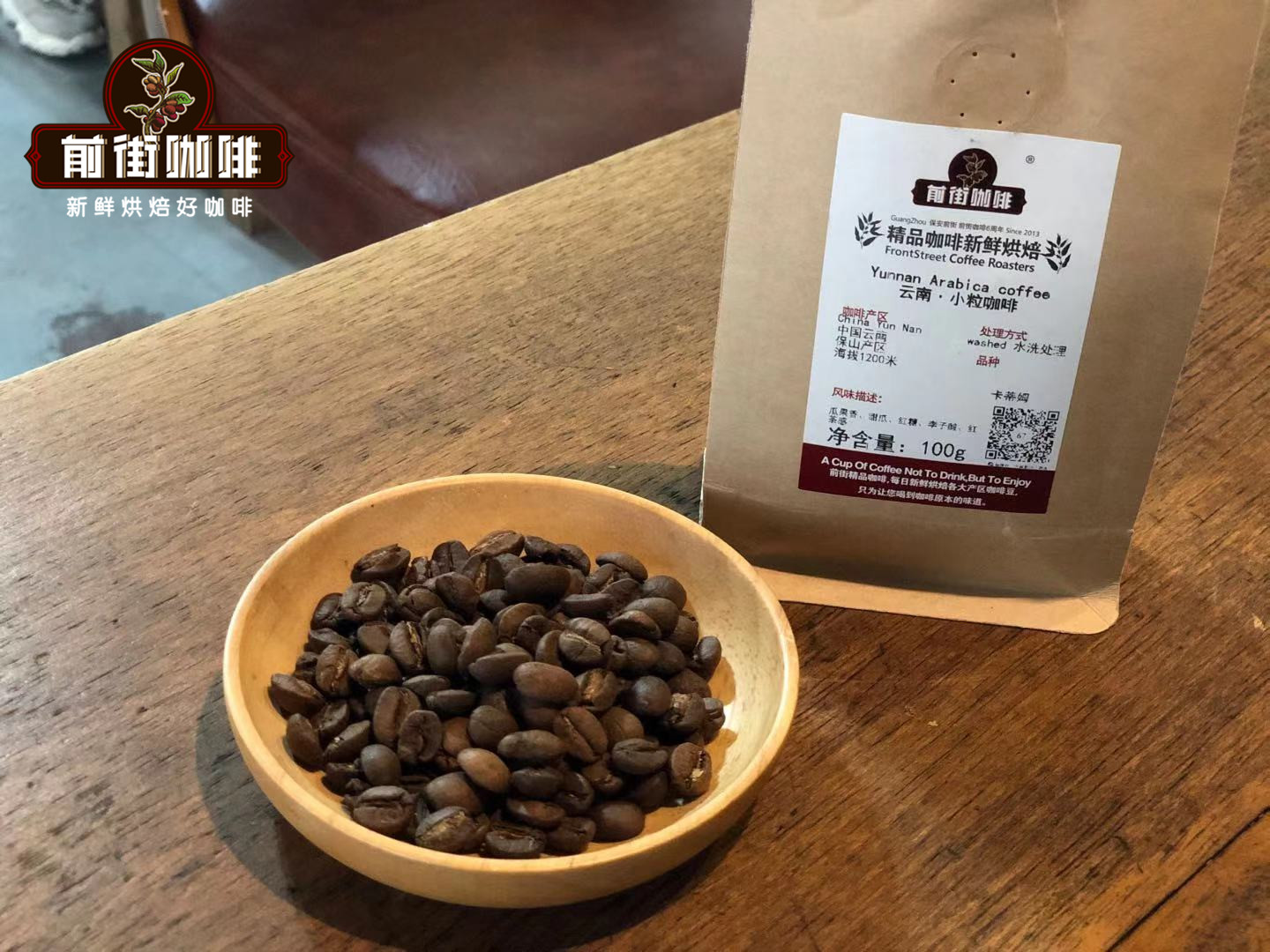
Introduction to the characteristics of Yunnan small seed coffee beans the flavor and taste of Yunnan hand-made coffee
[scientific name] small grain species are CoffeaarabicaL., medium grain species are Coffeacanephora, large grain species are Coffealiberica family genus: Rubiaceae Coffea [alias] small grain species, also known as Arabian species, medium grain species also known as Gaffra species, large grain species also known as large seed species
Development of Coffee Industry in Pu'er City, Yunnan Province
In recent years, our city closely revolves around the strategy of ecological establishment and green development, with the goal of developing agriculture with plateau characteristics and building a coffee capital of China, to establish and improve the guarantee mechanism and service mechanism to promote the healthy development of the coffee industry in the whole city. it has effectively promoted the large-scale, intensive and industrial development of the coffee industry in the whole city, and demonstrated the experiment of building the coffee industry into a national green economy in Pu'er.

Introduction to the Grinding Calibration of Katim Coffee Bean characteristics and Flavor description
Katim coffee beans characteristics of the region flavor description, taste treatment, grinding scale introduction, so we hand-picked on the spot, and finally picked out 9 kilograms of qualified, and by this time most of the morning has passed, of course, if it is used to make instant coffee or general commercial beans, high-yield catimor is a good choice, but want to find Yunnan specialty coffee, so old

Description of Coffee characteristics and Flavor of Katim Coffee introduction of Grinding scale in Manor Variety producing area
Katim Coffee characteristic Flavor description Manor Variety Grinding scale Yunnan Tiebika is softer and less sour than Blue Mountain. But overall, Tibica tastes light (it should be very light), but it has a long aftertaste. Baibang is a variety second only to Tiebika, which has a higher output and a stronger flavor, and it is not easy to buy on the market.

The most classic iron pickup fine coffee beans cultivation geographical location climate altitude profile
Coffee fruits take longer to develop. Coffee arabica fruit ripens in 810 months, usually in December of the year. Rainfall has a great influence on fruit development, and climate conditions directly affect fruit development of Arabica coffee berries. Typica and Bourbon are the two classic high-quality coffee varieties. In 1991, they were re-cultivated.
Cultivation Techniques of Coffea arabica in Yunnan
Control methods: ① strengthen management, reasonable pruning, appropriate shade. (2) Artificial killing of adults and larvae, timely cutting down and burning of damaged branches. 2. Coffee leopard wood moth. It is widely distributed and is one of the common coffee pests, which can harm a variety of economic crops. The larvae overwinter in the branches, and the larvae often eat upward in the branches, forming a tunnel of 30~60 cm. Prevention methods: ①

Common sense of coffee beans in Yunnan Dehong small grain coffee planting base
Dehong small grain coffee is native to Africa and Ethiopia and is the main cultivated variety in the world. In 1951, coffee seed was first introduced to Dehong Luxi Cotton cropping Experimental Station for productive cultivation. The seedlings were planted in 6 mu and grew well. In 1956, the Dehong Prefecture Committee decided to vigorously develop coffee in the whole state, and held a training course on coffee planting techniques throughout the state, so that small-grain coffee was widely developed in the whole state. 1958 de

A brief introduction to the description of the flavor, taste and aroma characteristics of high-quality coffee beans with excellent performance.
Due to the unique geographical environment and climatic conditions, Yunnan coffee has formed a unique flavor of strong but not bitter, fragrant but not strong, with a little fruit flavor. World-class coffee experts evaluate it as a good coffee in the world, and its cultivation techniques and per unit yield are also world-class. Yunnan coffee is a variant of the Arabian original species, which is generally called Yunnan small-grain coffee after long-term cultivation and domestication.

Introduction to how Lamper's "Manor Coffee" is made from High quality Blue Mountain Yunnan Coffee
Starting from Lancang County in Yunnan Province towards the border between China and Myanmar, we finally arrived at our destination after bumping for an hour on the rugged mountain road at an altitude of 1100 to 1500 meters. At this time in front of the scenery, I can not help but admire: ethereal white clouds around the dark green mountains, curling mist shrouded in the whole valley, just like Penglai Wonderland! The dense forest, the crisp birdsong, the breeze blowing, the sky
Common diseases and pests in coffee cultivation and their control methods
It is distributed in all coffee producing areas in the world, and it also occurs in Yunnan, Guangxi and Hainan Island in China. It is one of the major pests of coffee. The coffee tiger longicorn beetle harms the coffee trunk for more than 2 years and begins to eat between the cambium and the xylem.

Cultivation techniques of Chinese small-grain Coffee cultivation of Coffee varieties of Tieli Katim in Yunnan, China
Prevention and treatment methods: ① strengthen management, reasonable pruning, appropriate shade. ② artificially killed adults and larvae, cut off the damaged branches and burned them in time. two。 Coffee leopard bark moth. It is widely distributed and is one of the common coffee pests, which can harm a variety of cash crops. The larvae overwintered in the branches, and the larvae often ate upward in the branches, forming a tunnel of 30cm to 60cm. Prevention and control methods:

Yunnan Coffee Manor Lanpo "Manor Coffee" Coffee Flavor Taste Aroma Characteristics Description
Coffee trees bear fruit, and oval coffee beans hang densely on the branches. Xiao Yu said: Once the coffee fruit turns red, it can be picked. Coffee farmers to pick bright red coffee fruit picking, after strict selection and grading, remove diseased fruit, dead fruit and debris, and then coffee fresh fruit peeling degumming, cleaning can be placed on a special coffee drying rack drying, in order to maximize

A brief introduction to the Origin, Development, History and Culture of Iron Card Fine Coffee beans with slightly fruity Flavor
Small grain coffee is suitable for growing in the mountains at an altitude of 8001800 meters. If the altitude is too high, it will taste sour, and if it is too low, it will taste bitter. Small grains of coffee are mostly planted in dry and hot valleys about 1100 meters above sea level, so they are moderately sour, rich and mellow. There is a unique environment suitable for the growth of small seed coffee in many areas of Yunnan, and the quality of small seed coffee is excellent. The planting area is mainly distributed in the

Katim Coffee Bean Grown at Low Altitude History and Culture
Katim, as a breed that has taken root in Yunnan, I love and hate it. Although it had many shortcomings and was not suitable for high-altitude cultivation, there was still a lot of room for improvement, and it was getting better and better. How to discover more of its advantages and take advantage of it is the most important. In the domestic circle of popular light baking pursuit of sour aroma and sweet taste